CRYPTO 2025General Functional Bootstrapping using CKKS
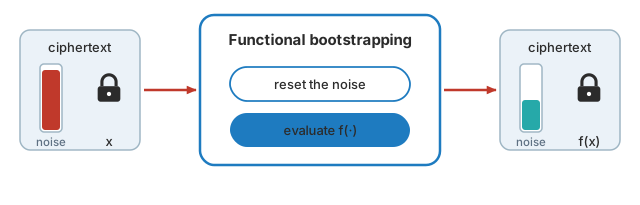
Brings functional bootstrapping to CKKS, so arbitrary functions can be evaluated during the refresh on encrypted real-valued data.
PNAS 2023Collaborative Privacy-Preserving Analysis of Oncological Data using Multiparty Homomorphic Encryption
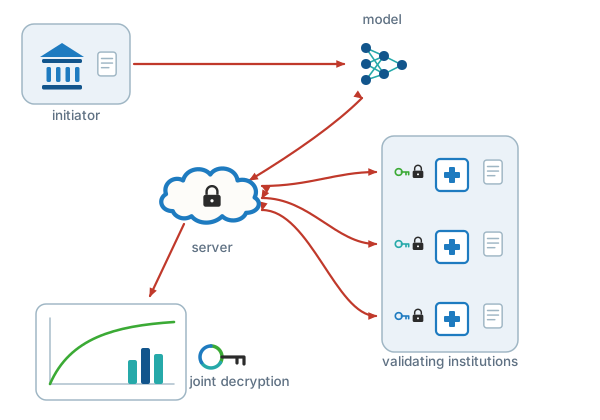
Encrypted analysis of real oncological data across institutions, a landmark deployment of multiparty homomorphic encryption.
SODA 2025Sublinear-Round Broadcast without Trusted Setup
Byzantine broadcast in a sublinear number of rounds with no trusted setup, against a dishonest majority.
ASIACRYPT 2022State Machine Replication under Changing Network Conditions
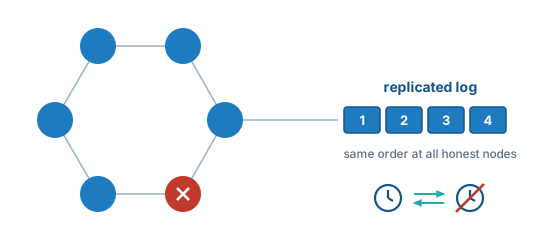
State-machine replication that stays secure and fault-optimal even as the network shifts between synchronous and asynchronous.
IEEE CSM 2021Encrypted Control for Networked Systems: An Illustrative Introduction and Current Challenges
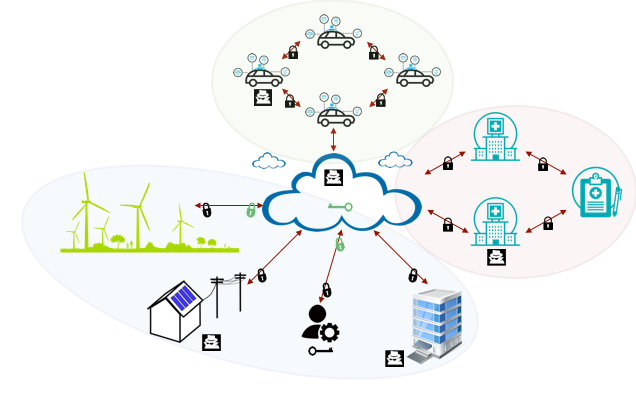
An accessible introduction to running control loops on encrypted data and the open challenges of the field.
IEEE TAC 2020Cloud-based Quadratic Optimization with Partially Homomorphic Encryption
A foundational framework in control for solving quadratic optimization problems on encrypted data in the cloud.
Research overview
Functional bootstrapping for CKKS
My current research centers on fully homomorphic encryption in its many flavors, including its threshold variants. I am particularly interested in developing and optimizing functional bootstrapping for the CKKS scheme.
Bootstrapping is the operation that refreshes a ciphertext so that an unbounded number of homomorphic operations can be performed on it; without it, computation on encrypted data is limited to a fixed, shallow depth. Functional bootstrapping goes one step further: instead of merely refreshing the ciphertext, it evaluates an arbitrary function during the refresh, turning an expensive but unavoidable maintenance step into useful computation.
Bringing this capability to CKKS, the scheme best suited to encrypted real-valued and machine-learning workloads, makes non-polynomial operations such as comparisons, activation functions, and table lookups practical at scale, which is a key enabler for efficient privacy-preserving analytics and machine learning on encrypted data.
A large part of my current research aims to bring privacy-preserving technologies to real-world deployment. Using and extending open-source libraries such as OpenFHE and NVFlare, I build privacy-preserving pipelines for tasks such as secure data querying and evaluation, including private information retrieval; scalable and secure collaboration for encrypted analytics over federated medical data; and efficient conversions (transciphering) between homomorphic encryption and symmetric ciphers.
Alongside performance, I study the security of approximate homomorphic encryption and how to configure it correctly for real deployments. This work is carried out at Duality Technologies.
Secure multi-party computation and distributed protocols
During my postdoc, my research interests were in secure multi-party computation and distributed cryptographic protocols such as broadcast and consensus. Although this line of work has already spanned decades, it has gained tremendous interest with the emergence of blockchains and, more generally, with the scaling up of distributed systems.
My collaborators and I designed efficient protocols for state machine replication and broadcast under various threat models and network-synchronicity assumptions. For instance, arbitrary changes in network synchronicity can render a protocol designed for synchronous networks insecure, while a protocol designed for asynchronous networks tolerates fewer faults even when the network is synchronous. I proposed common-subset and state-machine-replication protocols that have low communication complexity and tolerate the optimal number of faults even under arbitrary network transitions from synchronous to asynchronous.
I was also interested in robust differential privacy and anonymous communication systems, as well as in combining fully homomorphic encryption with complementary tools such as garbled circuits for private anomaly detection.
During my PhD, my main focus was the privacy and security of dynamical systems. Many of the structures around us are dynamical systems, from the time series of medical monitoring sensors to the energy consumption of our homes, and many abstract processes can be modeled as such, including iterative optimization algorithms like gradient descent and the training and evaluation of neural networks.
I designed privacy-preserving control and optimization algorithms built on homomorphic encryption and secure multi-party computation, which compute directly on encrypted data so that private information is not leaked to the computing party. Concealing dynamical data brings challenges beyond the static case: dependencies between data at different time steps, maintaining privacy across consecutive iterations, and accumulation of noise in the result.
My PhD projects spanned:
private cloud-based quadratic optimization from distributed private data;
linear and nonlinear cloud-based control on encrypted data;
private data-driven cloud-based control;
oblivious distributed weighted sum aggregation;
motion planning with secrecy guarantees that exploits the system's model.
Alexandru A. B., Kim A., Polyakov Y. and Zheng H., Sparse Hermite Interpolation Method for Discrete-CKKS Functional Bootstrapping, in International Conference on the Theory and Application of Cryptology and Information Security (ASIACRYPT), 2026, to appear. eprint
Dumezy J., Alexandru A. B., Polyakov Y., Clet P.-E., Chakraborty O., and Boudguiga A., Evaluating Larger Lookup Tables using CKKS, IACR Transactions on Cryptographic Hardware and Embedded Systems (TCHES), pp. 559-591, 2026(1), IACR. eprint
Adamek J., Aikata A., Al Badawi A., Alexandru A. B., Arakelov A., Binfet P., Correa V., Dumezy J., Gomenyuk S., Kononova V., Lekomtsev D., Maloney V., Nguyen C.-H., Polyakov Y., Pianykh D., Shaul H., Schulze Darup M., Teichrib D., Tronin D. and Arakelov G., FHERMA Cookbook: FHE Components for Privacy-Preserving Applications, in Proceedings of the 13th Workshop on Encrypted Computing & Applied Homomorphic Computing (WAHC), pp. 68-76, 2025, ACM. eprint
Alexandru A. B., Kim A. and Polyakov Y., General functional bootstrapping using CKKS, in Annual International Cryptology Conference (CRYPTO), pp. 304-337, 2025, Cham: Springer Nature Switzerland. eprint
Alexandru A. B., Loss J., Papamanthou C., Tsimos G. and Wagner B., Sublinear-Round Broadcast without Trusted Setup, in Proceedings of the 2025 Annual ACM-SIAM Symposium on Discrete Algorithms (SODA), pp. 4132-4171, 2025, ACM-SIAM. eprint
Alexandru A. B., Blum E., Katz J. and Loss J., State Machine Replication under Changing Network Conditions, in International Conference on the Theory and Application of Cryptology and Information Security (ASIACRYPT 2022), pp. 681-710, 2022, Cham: Springer Nature Switzerland. eprint
Alexandru A. B., Burbano L., Celiktug M. F., Gomez J., Cardenas A. A., Kantarcioglu M., Katz J., Private Anomaly Detection in Linear Controllers: Garbled Circuits vs. Homomorphic Encryption, in Proceedings of the 61st Conference on Decision and Control (CDC), pp. 7746-7753, 2022, IEEE. paper
Alexandru A. B., Tsiamis A. and Pappas G. J., Encrypted Distributed Lasso for Sparse Data Predictive Control, in Proceedings of the 60th Conference on Decision and Control (CDC), pp. 4901-4906, 2021, IEEE. paperarXiv
Alexandru A. B., Tsiamis A. and Pappas G. J., Towards Private Data-driven Control, in Proceedings of the 59th Conference on Decision and Control (CDC), pp. 5449-5456, 2020, IEEE. paper
Alexandru A. B. and Pappas G. J., Private Weighted Sum Aggregation for Distributed Control Systems, in Proceedings of the 21st International Federation of Automatic Control (IFAC) World Congress, 2020. paper
Alexandru A. B., Schulze Darup M. and Pappas G. J., Encrypted cooperative control revisited, in Proceedings of the 58th Conference on Decision and Control (CDC), pp. 7196-7202, 2019, IEEE. paper
Tsiamis A., Alexandru A. B. and Pappas G. J., Motion Planning with Secrecy, in Proceedings of the American Control Conference (ACC), pp. 784-791, 2019, IEEE. Finalist for best student paper award. paper
Alexandru A. B. and Pappas G. J., Encrypted LQG using Labeled Homomorphic Encryption, in Proceedings of 10th ACM/IEEE International Conference on Cyber-Physical Systems (ICCPS), pp. 129-140, 2019, ACM/IEEE. Finalist for best paper award. paperGitHub
Alexandru A. B., Morari M. and Pappas G. J., Cloud-based MPC with Encrypted Data, in Proceedings of the 57th Conference on Decision and Control (CDC), pp. 5014-5019, 2018, IEEE. paperarXiv extended versionGitHub
Alexandru A. B., Pequito S., Jadbabaie A. and Pappas G. J., On the Limited Communication Analysis and Design for Decentralized Estimation, in Proceedings of the 56th Conference on Decision and Control (CDC), pp. 1713-1718, 2017, IEEE. paperarXiv extended version
Alexandru A. B., Gatsis K. and Pappas G. J., Privacy preserving Cloud-based Quadratic Optimization, in Proceedings of the 55th Annual Allerton Conference on Communication, Control, and Computing, pp. 1168-1175, 2017, IEEE. paper
Alexandru A. B., Pequito S., Jadbabaie A. and Pappas G. J., Decentralized observability with limited communication between sensors, in Proceedings of the 55th Conference on Decision and Control (CDC), pp. 885-890, 2016, IEEE. paperarXiv extended version
Alexandru A. B., Lup S., Dita B., GDS2M: Preprocessing Tool for MEMS Devices, in Proceedings of the 8th International Symposium on Advanced Topics in Electrical Engineering (ATEE), pp. 1-4, 2013, IEEE. Third place in best student paper competition. paper
Journals and book chapters
Alexandru A. B., Al Badawi A., Micciancio D. and Polyakov Y., Application-Aware Approximate Homomorphic Encryption: Configuring FHE for Practical Use, IACR Communications in Cryptology (CiC), 2(4), 2026, IACR. eprint
Geva R., Gusev A., Polyakov Y., Liram L., Rosolio O., Alexandru A. B., Genise N., Blatt M., Duchin Z., Waissengrin B., Mirelman D., Bukstein F., Blumenthal D. T., Wolf I., Pelles-Avraham S., Schaffer T., Lavi L. A., Micciancio D., Vaikuntanathan V., Al Badawi A. and Goldwasser S., Collaborative privacy-preserving analysis of oncological data using multiparty homomorphic encryption, The Proceedings of the National Academy of Sciences (PNAS), 120(33), p.e2304415120, 2023. eprint
Alexandru A. B. and Pappas G. J., Private Weighted Sum Aggregation, IEEE Transactions on Control of Networked Systems, 9(1), pp. 219-230, 2021. arXiv
Schulze Darup M., Alexandru A. B., Quevedo D. E. and Pappas G. J., Encrypted control for networked systems: An illustrative introduction and current challenges, IEEE Control Systems, 41(3), pp. 58-78, 2021. arXiv
Alexandru A. B. and Pappas G. J., Secure Multi-party Computation for Cloud-Based Control, in "Privacy in Dynamical Systems", pp. 179-207, 2020, Springer, Singapore. arXiv
Alexandru A. B., Gatsis K., Shoukry Y., Seshia S. A., Tabuada P. and Pappas, G. J., Cloud-based Quadratic Optimization with Partially Homomorphic Encryption, IEEE Transactions on Automatic Control, 66(5), pp. 2357-2364, 2020. arXivGitHub
Technical reports and whitepapers
Al Badawi A., Alexandru A. B., Arakelov G., Gouert C., Gomenyuk S., Kononova V., Doröz Y. and Polyakov Y., Efficient Large-Integer Arithmetic for FHE, Cryptology ePrint Archive, 2026. eprint
Al Badawi A., Alexandru A. B., Bates J., Bergamaschi F., Cousins D. B., Erabelli S., Genise N., Halevi S., Hunt H., Kim A., Lee Y., Liu Z., Micciancio D., Pascoe C., Polyakov Y., Quah I., R. V. S., Rohloff K., Saylor J., Suponitsky D., Triplett M., Vaikuntanathan V. and Zucca V., OpenFHE: Open-Source Fully Homomorphic Encryption Library, Cryptology ePrint Archive, 2022. eprint
Preprints
Al Badawi A., Alexandru A. B., Polyakov Y. and Vaikuntanathan V., SoK: Private LLM Inference using Approximate Homomorphic Encryption, 2026. eprint
Alexandru A. B., Tsiamis A. and Pappas G. J., Data-driven Control on Encrypted Data, 2020. arXiv
Invited talks, workshops and posters
Multi-Skill Coding Agent for Encrypted Computation in OpenFHE, Aug. 2026, CRYPTO PPML Workshop, Santa Barbara, CA.
With Ahmad Al Badawi, Zohar Duchin, Yuriy Polyakov, Oded Rosolio, and Vinod Vaikuntanathan
A New Benchmarking Suite for FHE, Mar. 2026, FHE.org Conference, Taipei, Taiwan.
With Flavio Bergamaschi, Shruthi Gorantala and Shai Halevi
Evaluating Larger Lookup Tables using CKKS, Mar. 2026, FHE.org Conference, Taipei, Taiwan.
With Jules Dumezy, Yuriy Polyakov, Pierre-Emmanuel Clet, Olive Chakraborty and Aymen Boudguiga
Latest trends and results in PPML using FHE, Aug. 2025, CRYPTO PPML Workshop, Santa Barbara, CA.
With Ahmad Al Badawi and Yuriy Polyakov
Privacy-Preserving Data Sharing across Financial Institutions, Sep. 2024, NIST Workshop on Privacy-Enhancing Cryptography (WPEC2024), virtual.
With Kurt Rohloff
FHE-Related Comments on NIST First Call for Multi-Party Threshold Schemes, Sep. 2023, NIST Workshop on Multi-party Threshold Schemes (MPTS2023), virtual.
With Ahmad Al Badawi, Nicholas Genise, Daniele Micciancio, Yuriy Polyakov, Saraswathy R.V. and Vinod Vaikuntanathan
Building blocks for Threshold FHE, Sep. 2023, NIST Workshop on Multi-party Threshold Schemes (MPTS2023), virtual.
With Ahmad Al Badawi, Nicholas Genise, Daniele Micciancio, Yuriy Polyakov, Saraswathy R.V. and Vinod Vaikuntanathan
State Machine Replication under Changing Network Conditions, Jul. 2023, MongoDB Advanced Cryptography Group, New York City, NY.
Opportunities and Challenges of using Cryptography for CPS Security, Dec. 2022, Workshop on CPS Security, CDC, Cancun, Mexico.
Data-Driven Control over Encrypted Data, Jul. 2021, Autonomous Systems Laboratory, Stanford University, virtual.
Privacy for Cyber-Physical Systems, Oct. 2019, EECS Rising Stars at UIUC.